Looking to Transform Your Body? Recovery Is Vital
Why recovery matters for strength, performance, and long-term progress, plus the tools that can help your body bounce back.

From the desk of Meg Sharp, MSc., Fitness & Wellbeing Consultant, Cambridge Group of Clubs
Why Recovery is Essential for Performance and Progress
We’re often looking to transform some part of our body, mind, or spirit. And while maximal lifts, HYROX workouts, Zone 5 intervals, and mindful movement are powerful, no variable is more important, and more overlooked, than RECOVERY.
A quick review of the science on body transformation: Whatever you’re looking to accomplish: increase muscle, decrease fat, improve strength, power, or endurance; boost metabolism, cognitive function or memory; you cannot achieve these results without sufficient recovery.
I’ll say it again: On the journey to becoming your best you, recovery is vital.

Creating change requires the application of stress. The body initially responds to that stress by breaking down. “Oh!” it says. “I’m not strong/fast/smart/lean enough. I need to take the building blocks apart and build them back.Stronger/faster/smarter/leaner.”
The stress? Takes the blocks down.
Recovery - which can come in MANY different forms (keep reading!) - is what builds you back up. Better.
Not enough recovery?
Best case: Plateau.
Worst case: Deterioration, loss of your hard-earned gains, injury, burnout, yuck.
Recovery Tools to Support Your Training
Three of the most powerful recovery modalities are Nutrition, Sleep, and Rest. Unpacking the first variable is a monster of a conversation. Let’s save that for another day. Sleep and rest? Who has time for those? Currently - to be frank - I don’t.
Here’s the fabulous news. If you’re like me, we get it. That’s why we’ve curated amazing equipment and technology that supports optimal recovery. We want to ensure that as hectic as your schedule is, and as hard as you love to train, you can recover. It’s quick, efficient, and accessible. Before or after your workout, or simply when you need to take a few minutes to recharge.
It's time to embrace this awesome part of your transformative journey. Here are a few of our favourite recovery tools to help support muscle recovery, movement, and performance.
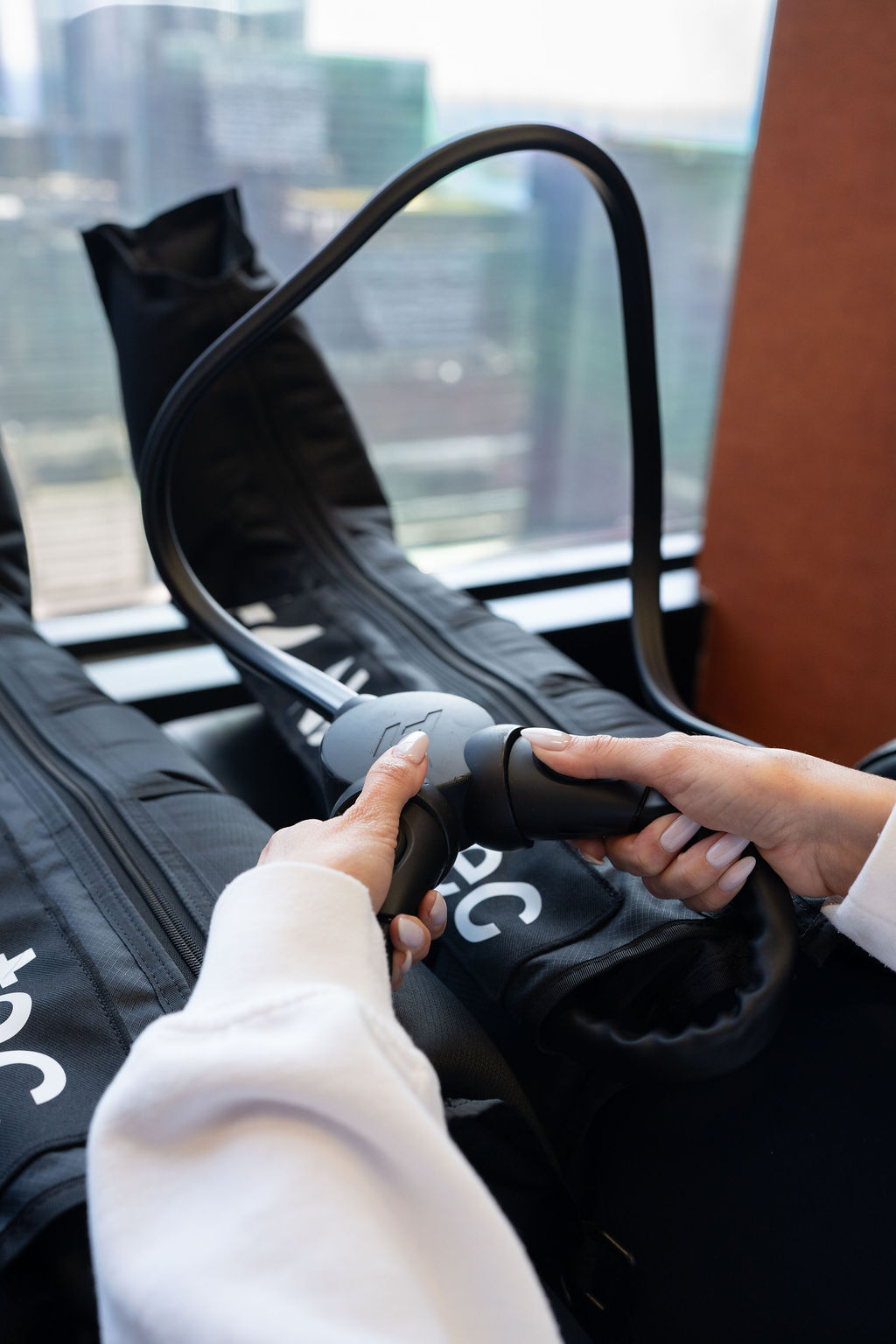
Normatec Compression Therapy
Dynamic compression increases blood flow, delivering oxygen and essential nutrients to fatigued muscle tissues. It reduces structural swelling and fluid build-up helping you regain muscular activation and power sooner.
Pro Tip: Short recovery flushes take 15-20 minutes. Deep recovery after long and/or intense training may require 45-minute sessions. Compression should feel firm but not painfully constricting.
Hyperice Vyper Vibrating Foam Roller
This dynamic foam roller combines self-myofascial release with deep tissue vibration therapy. Accelerate and optimize your warm-up. Flush lactic acid, mitigate inflammation, and reduce delayed onset muscle soreness (DOMS).
Pro Tip: Our flagship model features a distinct concave arch, allowing you to mitigate pressure while treating your spine and other sensitive bone structures.
Hypervolt Pro Gen 3 Percussion Therapy
Percussive vibration breaks up muscle tightness, reduces DOMS and flushes out metabolic waste. Specialized Heated Head Attachments increase local circulation faster and reduce tension both before and after training. Available at the Toronto Athletic Club only.
Pro Tip: Use daily to support optimal joint ROM and keep muscles pliable and responsive.
Questions About Workout Recovery?
At the Toronto Athletic Club, connect with Rob here
At the Cambridge Club, connect with Sean here